


Menu Search

#Spine Surgery

2 posts
Featured Publisher
hjk
jrm
Joey Montes @jrm · Sep 18
On August 4, 2026, I had a TLIF spinal fusion at L4-L5. TLIF stands for Transforaminal Lumbar Interbody Fusion. In simple terms, the procedure was performed to stabilize the L4-L5 level of my lower spine. The surgery involves placing an interbody cage and bone graft between the vertebrae, along with screws and rods that provide stability while the bones have time to fuse. Reading about spinal fusion is one thing. Going through it yourself is something entirely different. Surgery becomes a very real dividing line between what life looked like before the operation and what comes afterward. I am still moving through that process one day at a time. Recovery from spinal fusion is not measured by one dramatic moment. It is made up of smaller things: getting up, moving safely, rebuilding strength, being patient with the body, and understanding that healing continues long after the surgery itself is over. This photograph feels appropriate for this chapter of my life. There is nothing particularly complicated about it. It is simply me, looking straight ahead, carrying the experience with me. August 4, 2026 is now one of those dates I will always remember. It marks the day I had my L4-L5 TLIF spinal fusion and began the next part of the journey.
jrm
Joey Montes @jrm · Sep 18
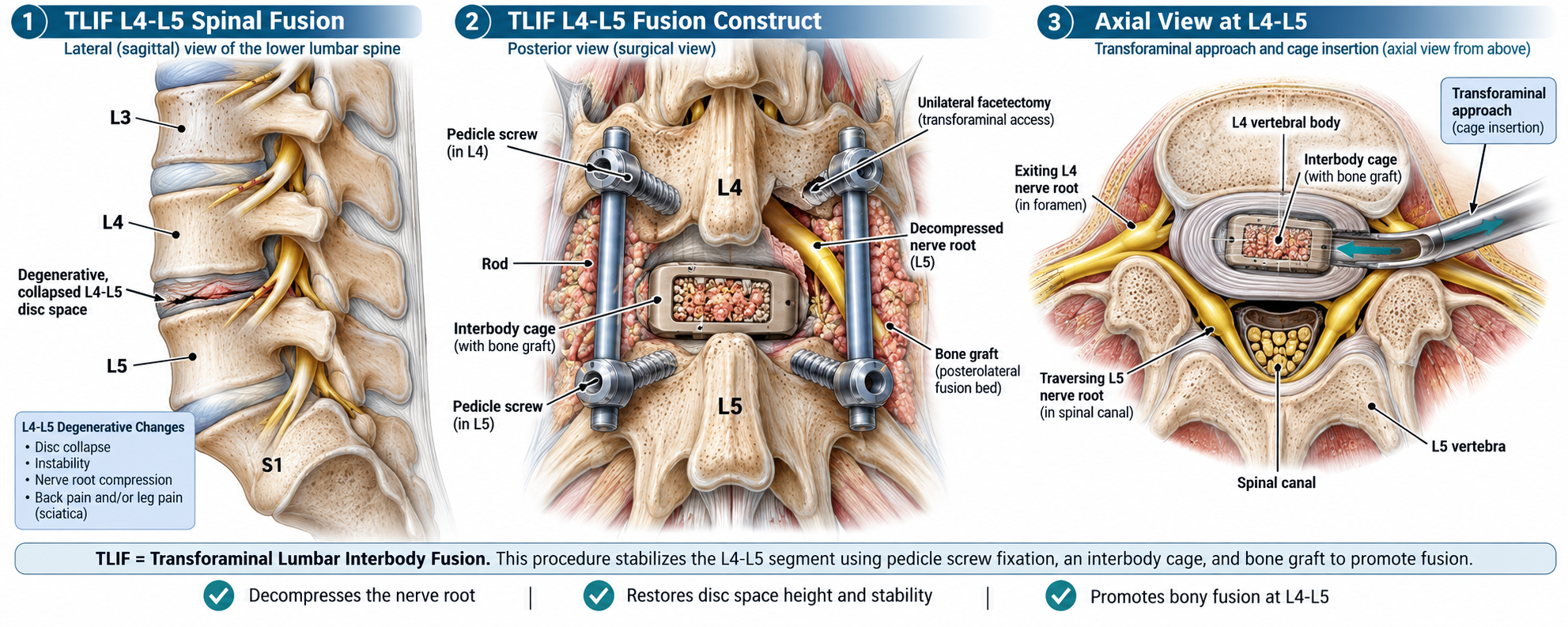
I wanted to share this graphic because it gives a clear look at what happens during a TLIF at L4-L5. TLIF stands for Transforaminal Lumbar Interbody Fusion. The procedure is designed to stabilize the segment between the L4 and L5 vertebrae while also creating more room for compressed nerves. The first view shows the lower lumbar spine from the side and highlights a degenerative, collapsed L4-L5 disc space. Changes at this level can contribute to instability, nerve compression, back pain, and pain that travels into the leg. The second view shows the fusion construct from the back. Pedicle screws are placed into L4 and L5 and connected with rods to stabilize the segment. An interbody cage filled with bone graft is positioned between the vertebrae, while additional bone graft can be placed around the back of the spine to support fusion. The third view looks down at L4-L5 from above and shows the transforaminal approach. This pathway allows the surgeon to reach the disc space from one side, decompress the affected nerve structures, remove damaged disc material, and insert the interbody cage. The goal is not simply to place hardware. The screws and rods provide immediate mechanical stability while the bone graft gradually develops into a solid fusion between L4 and L5. The procedure can also restore disc-space height and reduce pressure on the affected nerve root. This illustration does a good job of showing the three major parts of the operation: decompression of the nerve, stabilization with screws and rods, and the use of an interbody cage and bone graft to promote fusion. As with any spinal procedure, the exact surgical approach and recovery can vary from one person to another, so this is best viewed as a general educational overview rather than individual medical advice.

See Profiles

Feature coming soon!

Add Bio

Feature coming soon!

Likes

Feature coming soon!

Comments

Feature coming soon!

Reposts

Feature coming soon!

Share

Feature coming soon!